Remember those movies where the characters would talk to robots and machines that would respond in ways that made sense and sounded natural? Basically, those movies where technology communicated in a natural, human way?
Well, it looks like this type of science fiction is no longer fiction. It’s science fact, and the latest tool that’s taking the world by storm is ChatGPT.
Look anywhere on social media, and you’ll see posts, screenshots, and articles all about this tool. Statements from heavyweight Google have weighed in on how ChatGPT and other AI-generated content will be treated in search results.
And of course, there are many conversations around how ChatGPT will impact communications such as marketing.
In this article, we’ll go over the nuts and bolts of the latest generative AI revolution, what it can and can’t do, and how to use it in your digital marketing strategies.
What is ChatGPT?
So, what is ChatGPT?
While it’s not the first, nor probably the last of its kind, ChatGPT is a game-changing generative artificial intelligence (AI) tool, also known as a “chat box,” where users can give commands and watch it populate natural and articulate responses. It is capable of generating text in an array of styles, tones, and messaging that can be used for a variety of formats and purposes.
The difference between ChatGPT and its predecessor, GPT-3, and other AI chat boxes, is that ChatGPT delivers messages with a remarkable level of precision, coherence, and detail.
It is, to say the least, impressive.
ChatGPT is a Large Language Model that uses a unique technique called Reinforcement Learning from Human Feedback (RLHF). This means that the program uses human feedback as it trains and retrains itself to minimize biased, untruthful, or even harmful language. Beyond this, it also is able to mimic human tone and messaging. This is what makes it such a powerful tool.
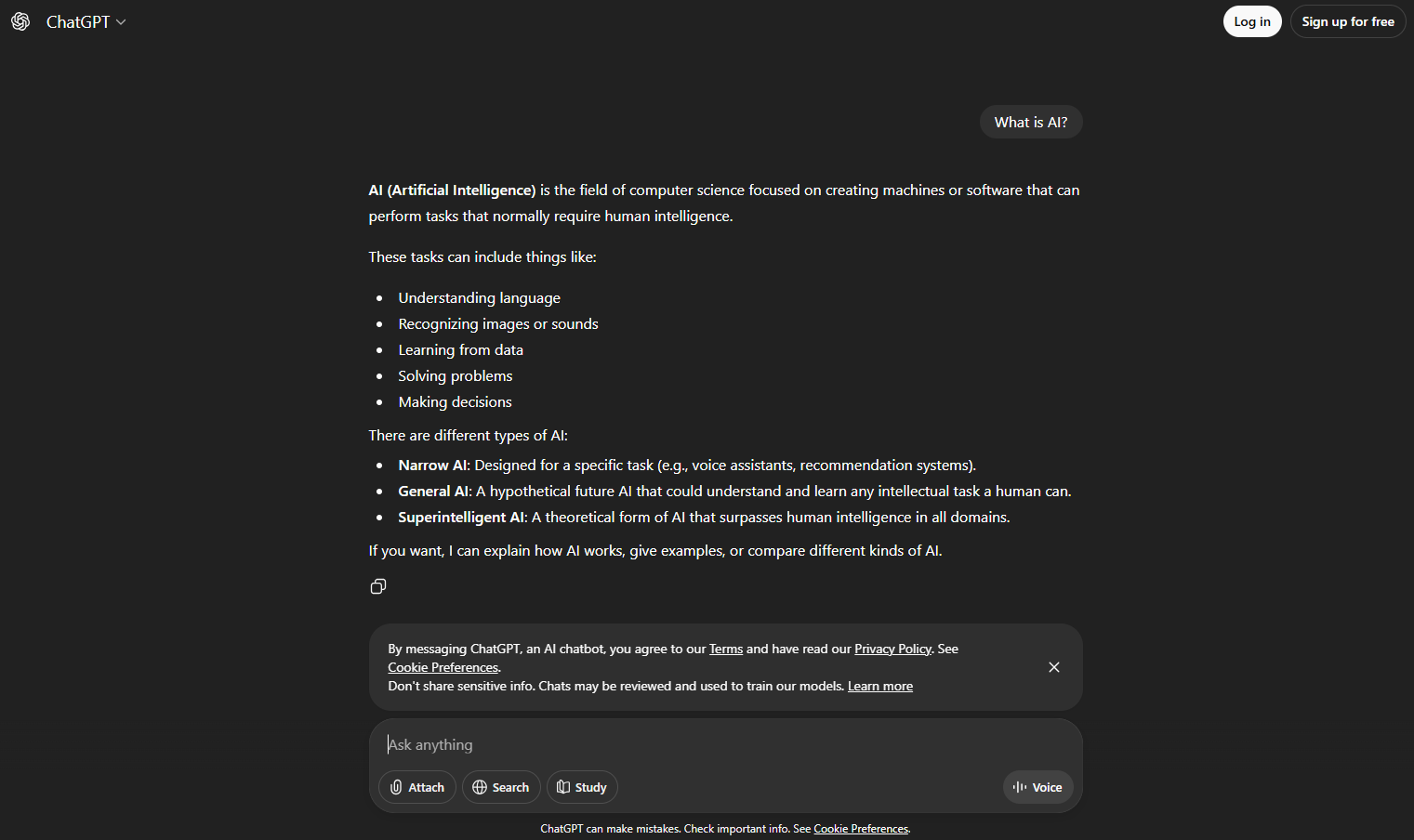
Let’s look at an example.
When we inputted What is AI? we got this:
What can ChatGPT do for marketers?
There’s a lot ChatGPT can do. Much of this can save you time and help you articulate your thoughts, which can be particularly useful when it comes to the fast-paced digital marketing world.
At the time of writing this article (February 2023; minor updates made in November 2025), here are a few of the key tasks that ChatGPT can do for you:
1. ChatGPT can generate bulk ideas and content quickly
A big part of digital marketing centers around content. Between social media, email marketing, and even blogs and articles, generating ideas for this content can be draining as a human task.
This is where AI can help your team. By using specific prompts and focusing on the skills that the program is adept at, ChatGPT can generate a whole bunch of ideas for your team to run with.
2. ChatGPT can help with audience insights and market research
Market research can be taxing and gaining audience insights sometimes can feel like skimming the ocean. But for marketers, particularly in a digital age, audience insights and market research require a multidimensional approach with continual revision and reassessment. As social media changes (and it’s been changing a lot lately), and the work world has shifted, digital marketers need to respond quickly.
This means a lot of time needs to be spent looking at your strategy. AI tools such as ChatGPT can streamline a lot of that work for you. It can help you gather and synthesize volumes of data, so you can get to the work of making informed decisions.
3. Gathering, condensing, and analyzing data
Again, market research requires analyzing volumes of data. While this can be done manually, that’s not exactly how marketers want (or even need) to spend their time. Doing this can also be tedious, taxing, and in the end, exhausting.
This is one of the areas that AI is stepping up. Tools like ChatGPT can eliminate this rote task by gathering, condensing, and analyzing large volumes of text-based information. Marketers can then continue with the high-cognitive and human-based task of deeper analysis, learning, and decision-making.
What can’t ChatGPT do for marketers?
ChatGPT is arguably one of the most advanced text-based AI systems, but even it can’t (and shouldn’t) do everything. At least not yet.
Here are some of the ways ChatGPT can’t be used, for various reasons:
1. ChatGPT, alone, isn’t appropriate for SEO content writing
As appealing as it sounds to have AI write your SEO blogs, it’s highly inadvisable. While ChatGPT’s capabilities can result in some pretty amazing stuff, Google has remained adamant that solely AI-written content may not necessarily rank well in search engine results pages (SERPs) if it’s not high-quality, reliable, or people-first.
In a recent Tweet, the search engine powerhouse said:
“For anyone who uses *any method* to generate a lot of content primarily for search rankings, our core systems look at many signals to reward content clearly demonstrating E-E-A-T (experience, expertise, authoritativeness, and trustworthiness).”

And they went on to say:
“Our spam policies also address automatically-generated content, where we will take action if content is ‘generated through automated processes without regard for quality or user experience’”.

One of the reported reasons why Google is not entirely on-board with AI written content is that Google will only support valuable, information-rich, and made-for-human content. Again, this goes back to Google’s E-E-A-T policy.
So, in essence, the reason for Google’s stance is not necessarily AI in general, but the drive to keep content humanized, nuanced, informative, and insightful.
This means that relying on AI-written content without thoroughly editing it and ensuring it’s quality content could harm your Google search results. This in turn can harm your business. AI-generated content is easily detectable by search engines and may even be watermarked soon.
2. ChatGPT (or any AI for that matter) is not entirely reliable or fact-checked
An extension of ensuring all your content demonstrates E-E-A-T, is the challenge of fact-checking. Basically, is AI writing actually true, verifiable, and objective? Is it well-informed and does the messaging offer a unique perspective, or does it simply reiterate the same thing as hundreds (or even thousands) of other content pieces out there?
Content written by AI writing tools, such as ChatGPT, should always be verified by a human fact-checker. Facts can change with updated information that may not have been inculcated into the AI program (yet). In fact, the makers of ChatGPT, OpenAI, were very clear when the tool was released that it has “limited knowledge of the world and events after 2021 and may also occasionally produce harmful instructions or biased content.”
In order to keep your brand content trustworthy and authoritative, it’s essential to make sure that what you’re putting out there is, in fact, true and up-to-date with the latest developments.
3. ChatGPT isn’t an autonomous and independent worker
What does this mean?
Well, ChatGPT, and any AI text-based tool, aren’t independent thinkers in the sense that they can’t think idiosyncratically or creatively. While AI is getting closer and closer to true human mimicry, there is still the need for human expertise in messaging and communication, along with out-of-the-box ideas.
Having said that, ChatGPT, and other AI text-based tools, still have a place at the table in that it can be an integral part of the process. Just don’t rely on it to be the whole process.
Ultimately, making the decision to use an AI tool is not a light one. For an extra resource, our friends over at Search Engine Journal have compiled this great list of 11 disadvantages of ChatGPT content.
Challenges when using ChatGPT for marketing
Any AI text-based tool comes with a learning curve but once that hurdle is cleared, there are a lot of amazing things you can do with it.
Here are a few of those hurdles that you might face when first starting with ChatGPT.
1. Getting used to nuanced and specific commands
As ChatGPT is a command-based AI tool, you need to learn what commands work and what don’t, and how specific you need to be when typing in commands.
Here’s an example of a fairly vague command.
We typed “Suggest one name for a marketing business” into ChatGPT and got this response:
Here’s a strong, versatile name for a marketing business: BrandRise Marketing
If you want more options (creative, modern, luxury, tech-focused, etc.), just tell me the style you prefer!
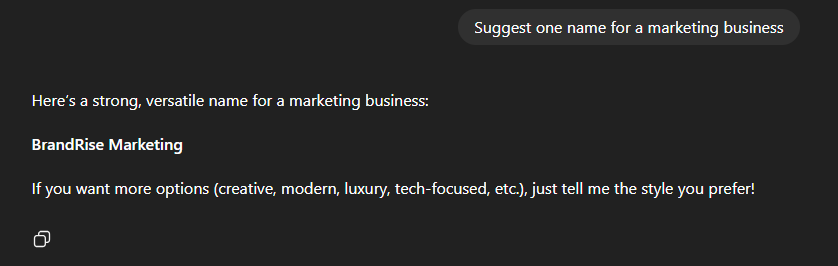
Not too shabby. The response provides some detail of why it was chosen, but overall the name isn’t too creative and chances are it already exists.
So, let’s get more specific.
We typed “Please suggest something that would indicate it’s specifically a digital marketing business and that would appeal to B2B tech brands using a friendly tone” and got:
Here’s a name that signals *digital marketing*, appeals to *B2B tech brands*, and keeps a friendly, approachable tone: BrightPixel Digital
Why it works:
- “Bright” feels positive, friendly, and human.
- “Pixel” clearly signals digital work.
- “Digital” makes the service offering explicit.
- The name feels modern and tech-aligned without being cold or overly corporate.
If you’d like, I can generate more options with different vibes—more playful, more tech-forward, more premium, or more creative.
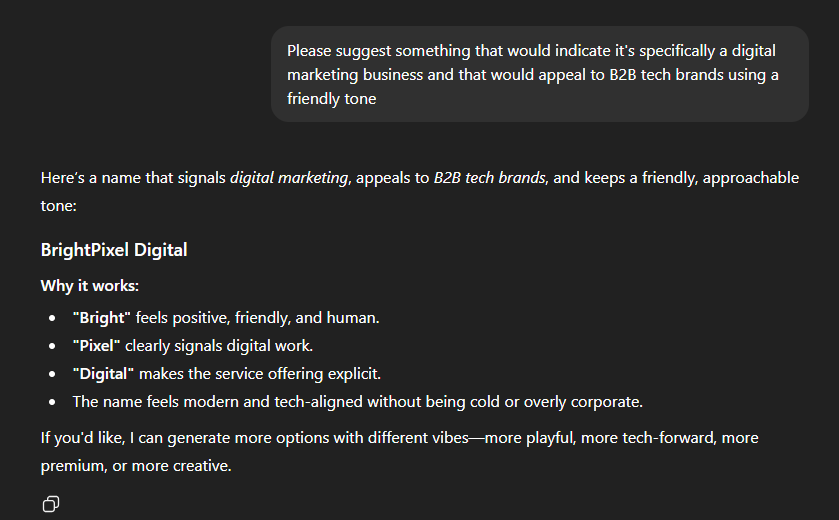
That’s more interesting!
The point here is that when using ChatGPT, you’ll get the best results when you already have a fairly substantial idea about what it is you want to get out of the tool. That’s the key.
2. Getting used to editing ChatGPT’s output
Using ChatGPT or other AI text tools also requires a solid understanding of writing. First, you’ll need to be ChatGPT’s editor, meaning you need to know the basic principles of grammar and punctuation. While ChatGPT may populate text that is technically grammatically correct, it may not read fluidly.
Next, you’ll need to assess structure and tone. While ChatGPT is very adept at mimicking human communication, does it align with the messaging of your particular brand? It’s possible it might sound like every other piece of content out there. That doesn’t help your brand or authority. While you’re doing so, make sure you insert your own thoughts too.
Lastly, you’ll need to assess for readability. This dovetails with structure and messaging, but look at your copyediting. Are the sentences short and concise? Are your paragraphs broken into digestible chunks?
Editing an AI-written piece of content can be involved, but it shouldn’t take too much time once you’ve got the hang of it.
3. Finding the right place for ChatGPT in your martech stack takes some consideration
Just because ChatGPT is a new and shiny thing, doesn’t necessarily mean it’s appropriate for everyone. If you do intend to explore this tool – or any AI text based tool – make sure it slides seamlessly into your martech stack. Otherwise, what is originally intended to be an efficient tool ends up becoming just one more tool to manage.
Before you hop on the AI bandwagon (and we’re not saying you shouldn’t), ask yourself and your team a couple of questions:
> What are you going to be using it for?
Will you be using this to help with content idea generation, social media, long-form text? What is it your team needs to offload so their expertise can be better used elsewhere?
> What problems are you trying to solve with this?
Are you and your team struggling with time management? Are you hoping to streamline processes and become more efficient? If so, where will this tool fit into your processes?
> What are you hoping to achieve with this tool?
This may seem redundant, but ask your team what everyone hopes to achieve with this tool? Is it to save time? Curb worker burnout? Help with large scale research, market research and analysis, or content and social media idea creation? Or is it for larger pieces such as longform, white papers, ebooks, and case studies?
Whatever you use AI text tools for, make sure it is the solution you need for your team. This might take a bit of time, which is why free trials are always welcome.
Other AI tools to consider to power up your marketing efforts
Of course, ChatGPT isn’t the only kid in the playground. Here are a few other text-based AI tools you might want to consider.
1. Rytr
Rytr is an AI writing assistant that specializes in generating shortform content.
What Rytr can write things like:
- Post captions
- Video descriptions
- SEO meta titles
- Emails
- Calls to action
2. ContentBot.ai
ContentBot.ai created both short and long-form copy and it has a unique “drag-and-drop” text builder that can help save time.
Some of the features of ContentBot include:
- AI paraphrasing tool
- Press release tool
- SEO tools
- WordPress plugin and Chrome extension
- Social content idea generation and copy
3. Copy AI
Copy AI is an AI-native GTM platform.
It can help you with tasks like:
- Prospecting
- Inbound lead processing
- Deal coaching & forecasting
- Account based marketing
- Content creation
- CRM enrichment
4. NeuroFlash
NeuroFlash offers a free plan of up to 1,000 words per month. While that works perfectly for very small businesses or individual freelancers, more robust packages are available.
Some of the features of NeuroFlash AI include:
- Website content creation
- Social media content creation
- SEO content creation
- Image generator
- AI chatbot
- Performance prediction tool
5. Simplified
Simplified offers a free forever plan, making this an attractive choice for very small businesses and individual freelancers. It boasts many features to help marketers AI-generated assets.
Some of the things you can do with Simplified include:
- Presentation creation
- Thumbnail creation
- Ad creation
- Image creation
- Video creation
- Blog writing