

Experts agree: quality longform content that offers value ranks higher than shorter content that is packed full of keywords.
Your SEO business strategy shouldn’t be primarily about peppering your content with keywords and hoping that will help your page rank high and keep your audience on your website.
It’s about providing a good experience that offers reliable and trustworthy information, keeps your audience engaged, and organizes your content in a way that is intuitive to find.
That’s where pillar pages can be your (and your audience’s) best friend.
What is a pillar page?
A pillar page is an anchoring piece of long-form content that serves as a hub around which subtopics can be built.
It’s that simple… and that complicated.
To really understand a pillar page, it’s important to also understand how content can be organized in a hierarchical way that ticks off both the SEO box and value offered box. A pillar page is just part of a “team” of pages (and content) that offers value. This “team” includes topic clusters and subpages.
What is a topic cluster?
Topic clusters are basically a grouping of content that cuts across different aspects of one broader topic
Think of topic clusters as similar to mind maps. They center around one key idea or topic, and each branch is an extension of the main idea or topic.
The cluster pages – or subpages – are anchored by the pillar page. Let’s look at an example of a topic cluster.
In this diagram, we can see that topic clusters “cluster” around a primary topic or concept. This primary topic or concept is what the pillar page will be about.
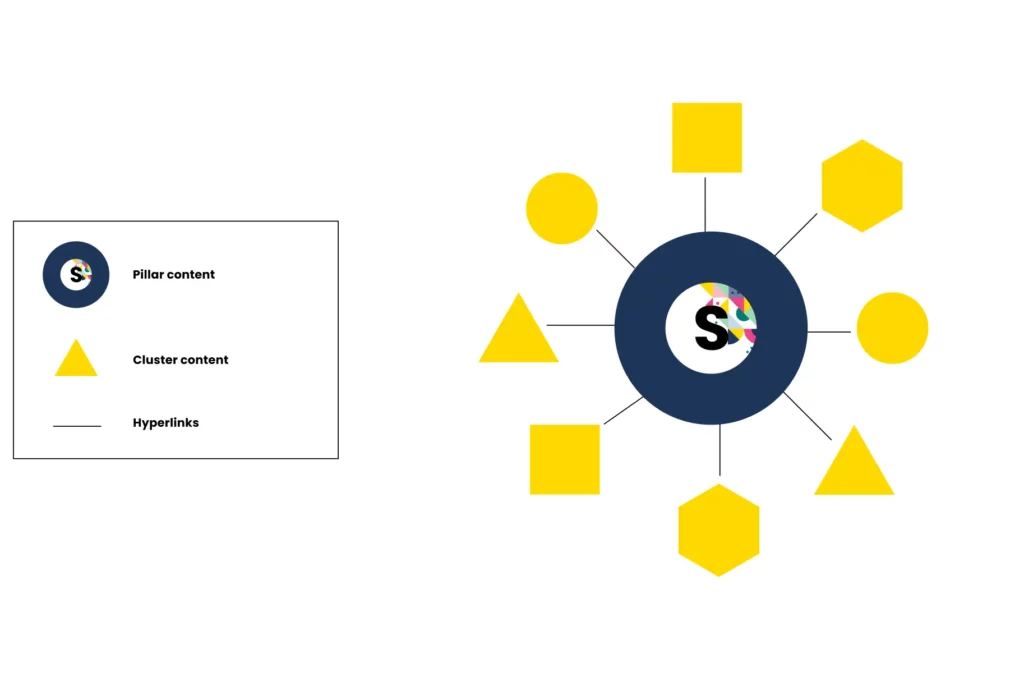
The subtopics are the branching bubbles which take one specific aspect of the broader topic and go more in depth.
If your audience wants more information on that specific aspect, that’s what those pages are for.
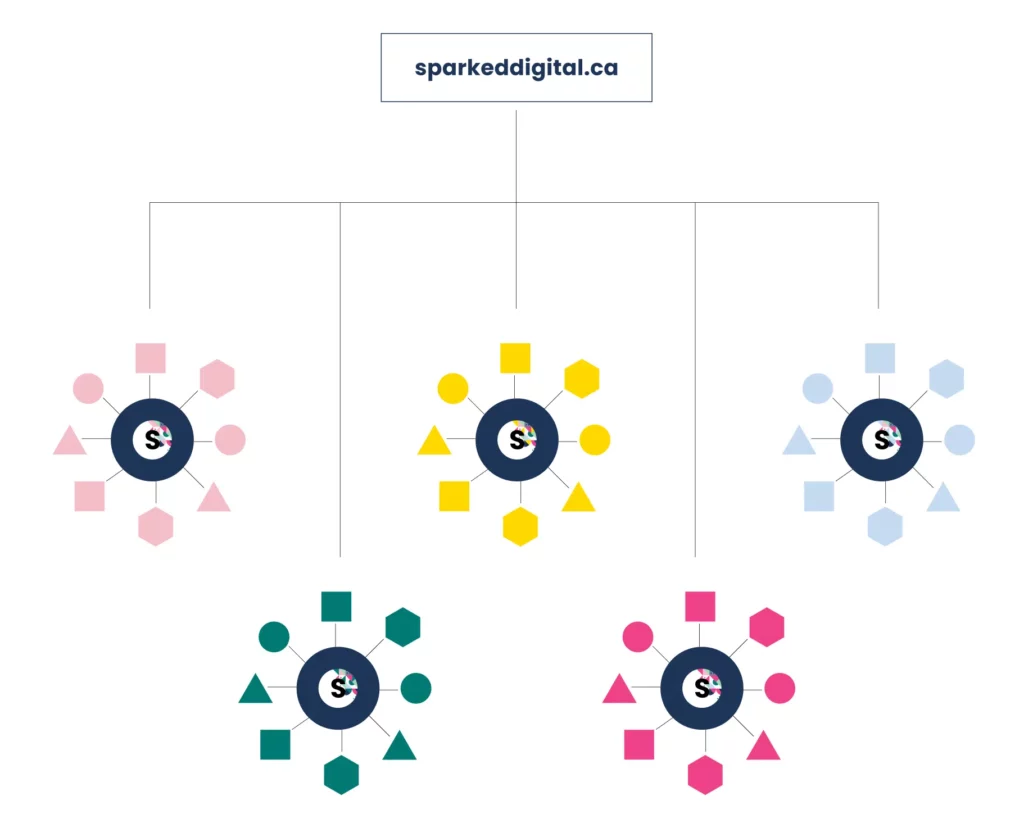
Here’s an organized website with cluster topics anchored by pillar pages:
What are subpages?
Where a pillar page is a piece of content that anchors other pieces of content, the subpages help to flesh out more detailed concepts that orbit around the larger topic.
These subpages are then hyperlinked in your pillar page, helping to keep your website organized and rounding out the full value of your information offering.
While it may seem like your pillar page is the most important aspect of your content offering on a particular topic, subpages are just as important. There’s a strong likelihood that your audience will want to know more about a particular aspect of your topic and it pays to be able to offer that information to them.
It’s like one-stop shopping.
Do you need a pillar page?
If used correctly, a pillar page and accompanying cluster pages will offer all the information and value your audience is looking for, in one place, and can offer a multitude of benefits for both you and your audience.
A pillar page can:
- Improve site structure
- Increase engagement by organizing your content into user-friendly topic clusters
- Encourages longer visitor sessions
- Keeps visitors within your content ecosystem
Easier to rank on search engines - Showcase your expertise, building brand authority and trust
Let’s look at some examples of pillar pages, starting with one of our pillar pages:
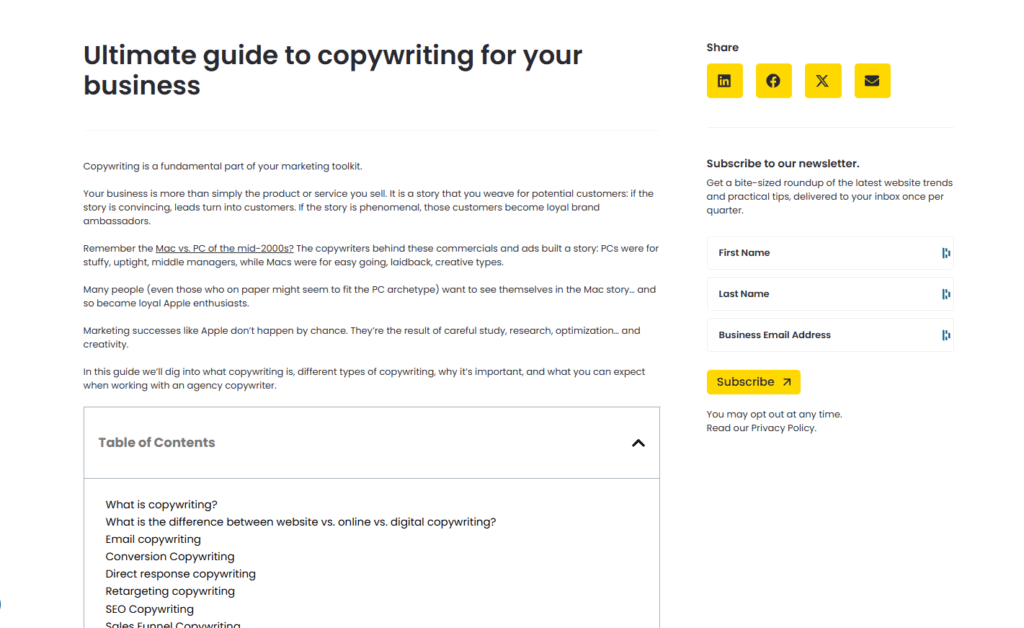
A pillar page can often be pretty easy to spot. Language like “The Ultimate Guide” signals a pillar page – and lets visitors know that, “hey, this guide is comprehensive and a great place to start.”
When choosing a pillar page topic, it’s like a Goldilocks test – don’t go too broad or you’ll find yourself writing a book-length slog. But don’t get too specific or you’ll risk your pillar page actually becoming a cluster page.
Let’s look at another example from Hubspot:
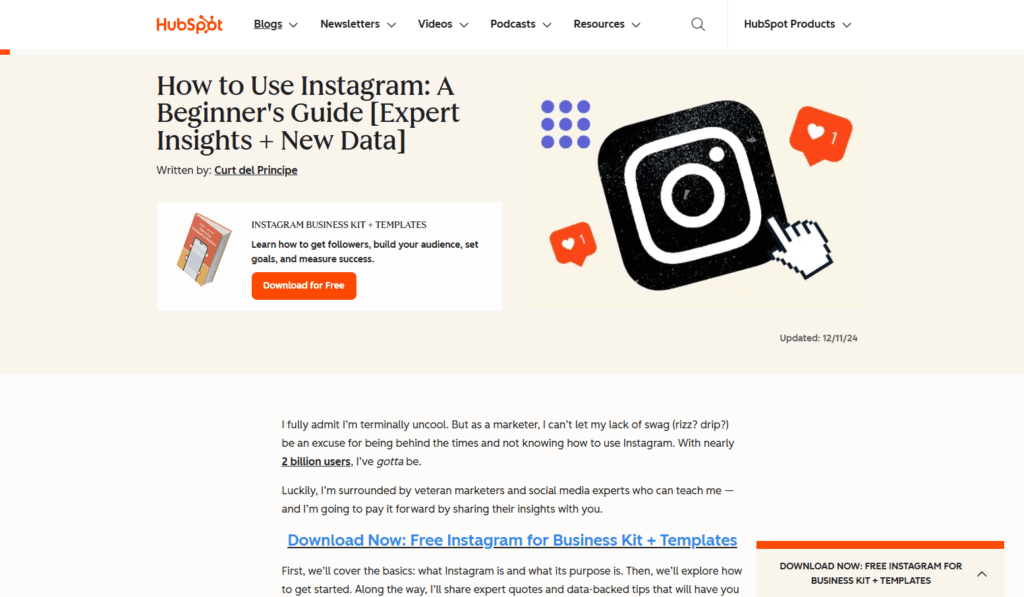
Here, we’ve got a “Beginner’s Guide” to using Instagram. The page is extremely long and goes into great depth and detail about this topic. Based on this, we can guess that this is one of Hubspot’s pillar pages.
Here’s another example from Monday.com:
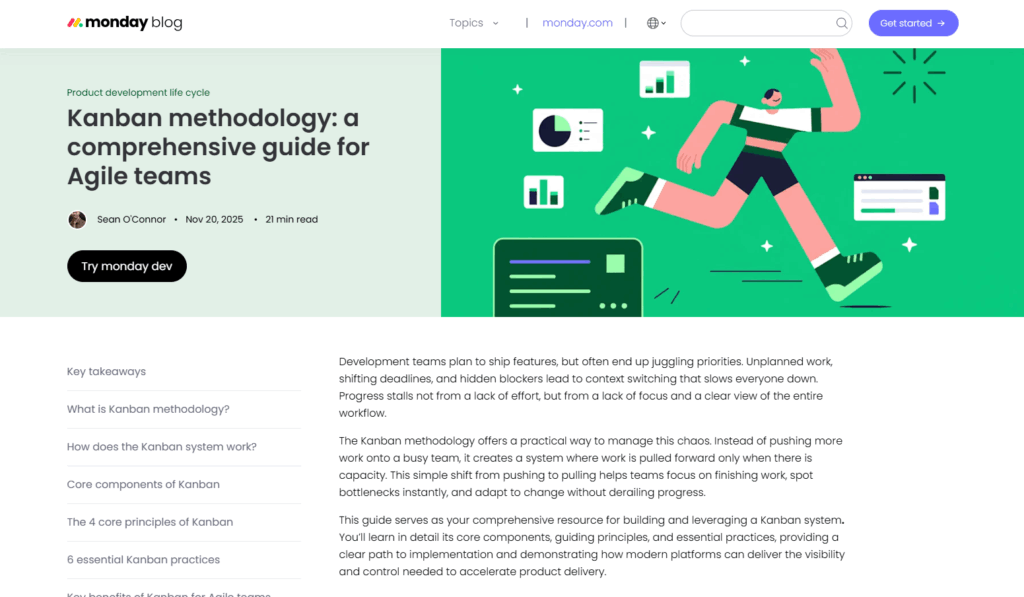
This pillar page is niche and industry specific. We can guess this is a pillar page because this page provides a wide overview of what the Kanban methodology is, along with a table of content outlining it’s extensive information. It’s a 101-style guide that provides value to the audience and is easy to navigate.
Now that we’ve looked at some examples, let’s talk about what makes a pillar page effective.
What makes an effective pillar page?
Creating an effective pillar page isn’t like throwing spaghetti at the wall and hoping it sticks. It should be strategic.
Just like anything content marketing, there are aspects to an effective pillar page that can (and should) be replicated:
1. Descriptive title
Pillar page titles are generally short, sweet, and to the point. This is strategic as your pillar page is the hook to drive traffic to your website, and where keywords should be optimized with that strategy in mind.
This is where we see language like “The Ultimate Guide to X” or “How to X” or “Everything you need to know about X.”
2. Ungated and accessible content
Ungated content means content that is openly accessible to all audiences. There is no exchange in order to access this valuable information, such as an email signup, a free trial, and so on.
Accessible content also means easily navigable content. Because of the nature of pillar pages and their propensity towards long-form, the structure of your content in a pillar page should be carefully thought out.
There are pillar page templates available, but if you want to make the most of your pillar page – and your audience’s time – you may have to break a few template rules and go rogue.
3. Easy to navigate and well structured
Because a pillar page is a long-form piece of content (which can sometimes exceed 2,000 words), breaking up that content into easy-to-navigate sections will help. The order of the sections should flow in a logical order.
Think of your pillar content as telling a story. You wouldn’t start in the middle, or jump to a concept that you haven’t already built the foundation for. This is a story you’re telling your audience that requires logical organization.
This is where a Table of Contents – preferably one that is hyperlinked to the sections – can make your pillar page pop.
4. External resource links
While one main function of a pillar page is to build your cluster topic and underscore your value, don’t forget to link to external resources. This is because, first and foremost, your pillar page should be an invaluable resource for your audience, and that includes providing them with the best guidance you possibly can.
The purpose of using external resource links is multifaceted: external resource links that are relevant and offer value typically helps:
- Your website achieve higher search engine rankings
- Engage visitors while building trust
- Establish yourself as a subject matter expert
But remember: only include an external resource link if it makes sense to do so. And find a healthy balance between internal and external links.
5. Call to action (CTA)
Of course, a call to action is always crucial. This doesn’t just apply to pillar pages, but a lot of your pages.
Because a pillar page is a top-funnel piece of content, you want it to ultimately push visitors down the sales funnel and eventually, drive conversions. A clear and effective CTA will help do so.
Even if your audience – your prospects – don’t immediately click on that CTA, it’s not always easy to measure conversions. Visitors may be mulling over your content or offering for a while before they return, or they could be sharing your content – and thus, your brand authority – with others via dark social (social shares that are difficult to measure such as text message shares, social media DMs, and emails).
Types of pillar pages
Despite pillar pages mostly serving a common purpose – to attract traffic to your website and keep visitors exploring for longer – there are a few different types of pillar pages.
Resource or “guide” pillar page
A resource or guide pillar page is typically comprehensive and covers all aspects of the topic.
Here’s where language like “Ultimate Guide,” and “How To” work as pillar pages. It could be something aimed at beginners, or more industry-specific.
A resource or guide pillar page serves to:
- Establish you as an expert in that topic
- Build your brand
- Establish trust with your audience
A resource or guide pillar page can attract a lot of attention, particularly if it’s timely. Publishing a resource that focuses on trends for 2025 halfway through 2026 isn’t going to do you (or your audience) any good.
Evergreen topics work well too, but just like a timely topic, evergreen content still works well when people are searching for it the most. Just because it’s evergreen, doesn’t mean interest doesn’t wax and wane.
The “How to” pillar page
The “How to” pillar page is a page similar to the resource or guide pillar page explained above, but it’s a more specific piece of content that offers a step-wise solution to an audience’s pain point – how do I do X? And, of course, you are the expert so you are the one most primed to guide them through the steps.
A “How to” pillar page provides a solution to your audience that offers a lot of valuable and useful information. It can even be a piece that your audience refers to multiple times, thus underscoring your position as a topic expert.
“How to” pillar pages are often accompanied by graphics or illustrations, which help guide the audience through the steps.
The product or service pillar page
A pillar page can showcase either all of your products and/or services or just your flagship ones, and can even double as a landing page.
A product or service pillar page serves primarily one goal: make it easy for your prospects to learn about your offerings.
This type of pillar page can give prospects a price comparison or features of different tier subscriptions.
****
Regardless of your industry, if your website provides valuable content, or showcases your products or services, a pillar page should be an essential part of your value.
Want help taking your pillar pages to the next level and driving traffic to your website? At Sparked, we offer pillar page and subtopic copywriting, design, development and optimization.
Contact us today to book a free discovery call.


